The Modern Man’s Guide to Grief Podcasts: Why The Dead Dads Podcast Offers a Different Path
A lot of grief content sounds like it was written for someone sitting quietly by a window with herbal tea and a soft blanket. That works for some people. For others, especially men dealing with the death of a father, it can feel miles away from their life.
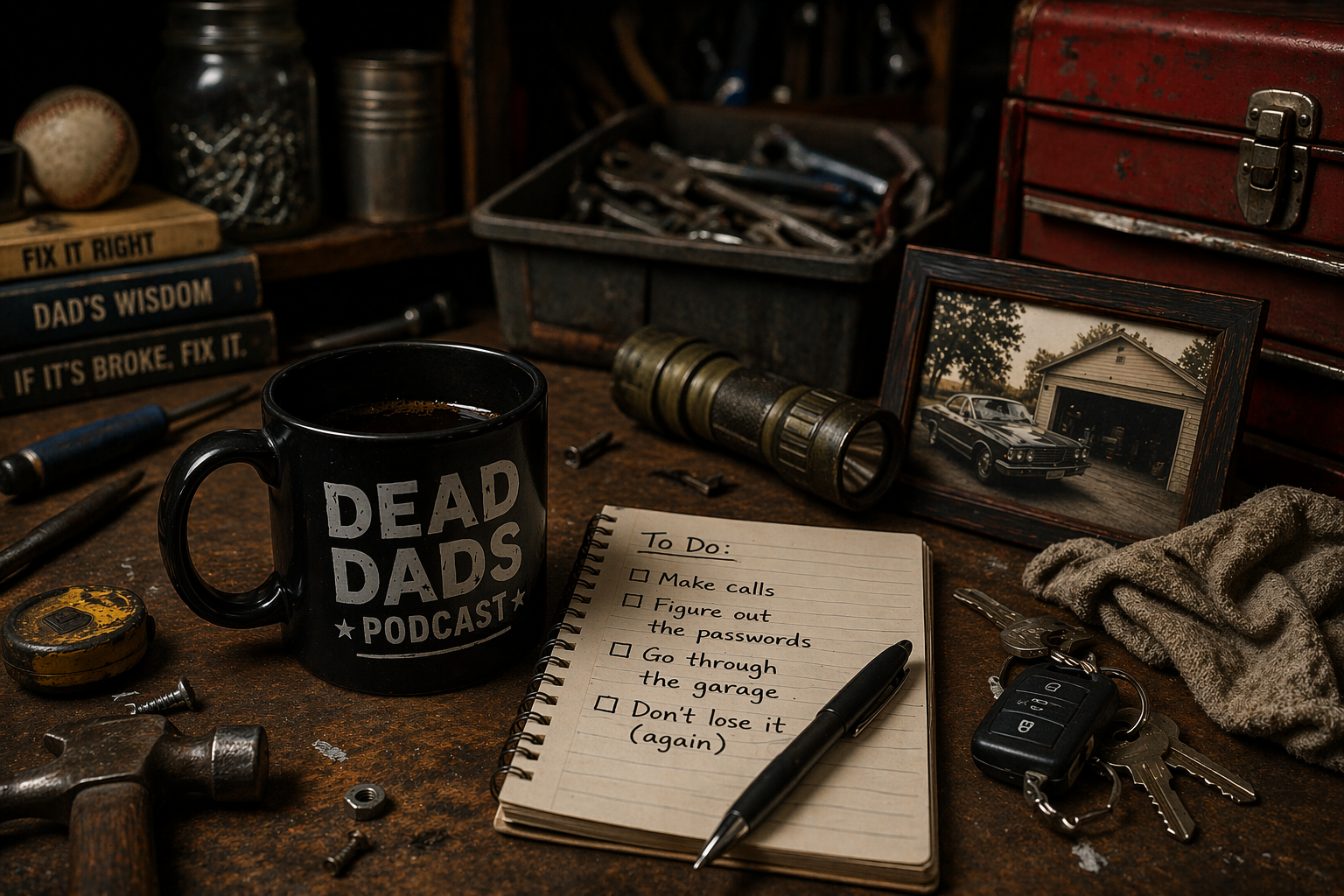
Losing your dad ideally feels messy. It can look like paperwork, family tension, random anger, weird silence, grocery store meltdowns, crying in your car, crying in your shed, and then suddenly having strong opinions about whether to keep a broken drill from 1997. Dead Dads is built around that version of grief. We cover “everything that comes with losing your dad,” including the things people usually skip: paperwork marathons, garages full of “useful” junk, password-protected iPads, and grief that shows up in the middle of a hardware store.
That difference matters. There are a lot of grief podcasts. Some are thoughtful. Some are useful. Some are probably helping people right now as we speak. But many are broad by design. They talk about grief as a universal experience, which is fair enough, except father loss often has its own shape. For a lot of men, it is tied up with masculinity, family role, responsibility, unfinished conversations, and the pressure to hold everything together while looking normal in public. Dead Dads takes that on directly.
Why grief can feel different for men
Men are often taught to stay useful before they stay honest. So when a dad dies, many men go straight into function mode. Handle the calls. Move the stuff. Keep the family steady. Go back to work. Don’t melt down in the cereal aisle. Then, weeks or months later, grief walks back in like it owns the place. That pattern shows up clearly across the show’s episodes including “You’re Not Doing Grief Wrong | Here’s What’s Actually Happening”, which describes grief as something that can hit later, out of nowhere, and in ordinary moments, and “It’s Okay Not to Be Strong After Your Dad Dies”, which speaks directly to the script many guys run after loss: hold it together, stay steady, don’t make it weird for everybody else.
That is one reason a lot of men bounce off traditional grief language. It can feel too polished, too generalized, or a little too eager to get to healing before the listener has even admitted he is wrecked. Male grief is often messier than that. It can look like numbness, workaholism, dark humor, short tempers, obsessive practicality, and sudden emotional sinkholes. The Dead Dads Check-In episode on grief after your dad dies makes exactly that point. It frames grief not just as sadness but as guilt, laughter, rituals, random memories, crying in front of your kids, and the question of what to keep and what to throw out.
Father loss also has a strange identity charge. When your dad dies, you are not just grieving him. Sometimes you are also grieving the person you were with him around. The guy who could still ask for advice. The guy who was still someone’s son in an active, living sense. Some episodes lean into that directly. “The Pressure Nobody Warns You About After Losing Your Dad” is built around the pressure that shows up after the loss, and “You Think You Have Time With Your Dad… Until You Don’t” points at the way men assume there will be more time until there suddenly is not.
Why podcasts can help when grief is hard to talk about
Podcasts are useful for grief for one very simple reason: they let people listen before they are ready to explain themselves. You do not have to introduce yourself to a room. You do not have to fill out an intake form. You can listen while driving, walking, cleaning the garage, or pretending to reorganize a drawer you have opened twelve times this week for no clear reason.
That privacy matters. Audio is intimate and low-pressure. It can keep a man company without making demands. And when the voices sound like actual people instead of laminated guidance counselors, it gets easier to stay with the material. Dead Dads is explicit about the lane it is in. We describe it as “a grief support group for men that laughs way too much,” and we aren’t doctors or therapists. That restraint helps. The show is not pretending to replace therapy, friendship, or actual support. It is offering recognition, perspective, and language men can live with.
That distinction is important. A grief podcast should not promise to fix grief. That would be ridiculous, and also annoying. What it can do is help a listener feel less alien in his own life. It can say: yes, that weird thing counts. Yes, dark humor is a thing. Yes, the garage junk matters. Yes, crying in front of your kids does not mean you have failed some sacred code of manhood. The show says exactly that in the Check-In episode, which includes “permission to cry in front of your kids without feeling weak” among its takeaways.
What most grief podcasts get right, and where they often fall short
To be fair, many grief podcasts do useful work. They normalize loss. They make room for conversation. They bring in therapists, experts, writers, caregivers, and people with lived experience. Some are very good at helping listeners feel less alone. The problem is not that the category is broken. The problem is that many men dealing with father loss are listening for something more specific.
That is where the usual gap opens. A broad grief podcast may talk about loss in a way that feels compassionate but not familiar. It may leave out the practical aftermath. It may skip over complicated dads. It may lean hard on uplift when the listener mostly wants someone to admit the experience is absurd, lonely, and badly designed. Dead Dads positions itself in that gap. We empathize the things people usually skip, and the recent run of episodes is full of father-loss-specific topics: grief hitting later, dark humor, the pressure to be strong, the family fallout after “the call,” what grief looks like years later, and what men are actually dealing with after a dad dies.
That is the show’s big advantage. It is not trying to be a universal grief resource. It is trying to be useful to men dealing with the death of a father. Narrower target. Better fit.
What makes The Dead Dads Podcast different
The first thing is tone. Dead Dads does not sound like content approved by a committee called “Calm Feelings Task Force.” It sounds like people talking the way people actually talk when something awful has happened and life keeps going anyway. We describe the show as “one uncomfortable, occasionally hilarious conversation at a time.” That is not just a tagline. It is the whole posture.
The second thing is topic selection. A lot of shows gesture toward grief. Dead Dads keeps dragging grief into the room by the collar and making it talk about real things. We talk about paperwork, passwords, family rituals, random sayings, garage clutter, the burden of holding the family together, therapy, crying in front of your kids, and the weird timing of grief. That makes the show feel less like a set of reflections and more like company during the actual aftermath. Try “He Got the Call… and Had to Tell His Family His Dad Was Dead” for the shock-and-immediate-responsibility version, “The Pressure Nobody Warns You About After Losing Your Dad” for the burden-and-function version, and the Check-In episode for the day-to-day, keeps-catching-you-off-guard version.
The third thing is that it leaves room for contradictory emotions. Father loss is not always clean love followed by clean sadness. Some men loved their dads and miss them in obvious ways. Some had difficult fathers, intimidating fathers, absent fathers, or relationships that got better too late. Some feel grief mixed with anger, regret, guilt, relief, or all four before lunch. That complexity appears in “20 Years Later — What Grief Looks Like When the Dust Settles”, where Mike Wasko talks about an intimidating father, caregiving, reconciliation, therapy, and the way grief changes over decades rather than disappearing.
The fourth thing is humor. This matters more than polite grief culture likes to admit. Humor is not disrespect. Humor is one of the oldest pressure valves on earth. Men use it to survive, to connect, to delay, to test whether it is safe to say the darker thing. Dead Dads is upfront about this. The site calls it “a grief support group for men that laughs way too much,” and the episode “Why Dark Humor Helps When You’re Grieving” is built squarely around that idea.
That combination is rare. Direct male voice. Father-loss specificity. Practical aftermath. Emotional contradiction. Humor without becoming a stand-up set in a funeral home lobby. It gives the show a lane that feels more like life than content.
If that sounds closer to the kind of grief support you can actually stand listening to, start with the Dead Dads episodes page.
Who The Dead Dads Podcast is for
This show may be for you if your dad just died and your brain now runs on static and administrative dread. It may be for you if it has been years and grief still catches you sideways. It may be for you if you had a complicated relationship with your father and do not want to be fed a fake, one-note emotional script. It may be for you if you are tired of grief content that sounds too polished, too broad, or too allergic to laughter. The recent episode set supports all of those entry points, from immediate aftermath to long-tail grief to emotional confusion.
A few good starting points:
If your dad just died, start with “He Got the Call… and Had to Tell His Family His Dad Was Dead” or “You’re Not Doing Grief Wrong | Here’s What’s Actually Happening”. Both are positioned for men dealing with the first disorienting stretch after loss.
If you feel pressure to hold it together, start with “It’s Okay Not to Be Strong After Your Dad Dies” and “The Pressure Nobody Warns You About After Losing Your Dad”. Those are basically anti-statue episodes. Useful if you are tired of cosplaying as the stable one.
If your grief looks messy, uneven, and a little weird, start with the Dead Dads Check-In. It gets into rituals, random memories, keeping or ditching your dad’s stuff, and crying in front of your kids.
If dark humor has been one of the few things keeping your head above water, start with “Why Dark Humor Helps When You’re Grieving”.
If it has been years and you still feel it, start with “20 Years Later — What Grief Looks Like When the Dust Settles”. That one is valuable partly because it does not sell closure. It shows how grief changes shape over time. Better. More honest. Less irritating.
Who it may not be for
This podcast may not be for you if you want a therapist-led show with a clean self-help structure. It may not be for you if you want grief discussed in a very gentle, non-comedic frame. It may not be for you if dark humor around death feels wrong to you. That is fine. Good positioning excludes people. It does not need to audition for everyone.
But if you want a grief podcast for men that sounds like real people talking about father loss, and not like a pamphlet got hold of a microphone, Dead Dads is unusually well aimed.
The grief topics men are actually searching for, and how Dead Dads addresses them
A lot of men are not searching for “my healing journey.” They are searching for practical, awkward, specific things.
They are searching for what to do when your dad dies. “He Got the Call…” goes straight at the sudden-loss, immediate-family-responsibility version of that.
They are searching for why grief feels strange or delayed. “You’re Not Doing Grief Wrong” addresses exactly that, describing grief as cryptic and talking through why it can hit later or out of nowhere.
They are searching for whether men are allowed to cry, shut down, laugh, or feel all over the place. The Check-In episode includes “permission to cry in front of your kids without feeling weak,” while “Why Dark Humor Helps When You’re Grieving” frames laughter as part of coping rather than evidence that you are broken in a fun new way.
They are searching for the pressure that lands after a father dies. “The Pressure Nobody Warns You About After Losing Your Dad” exists for that exact reason.
They are searching for what grief looks like years later. “20 Years Later” covers that, including therapy, caregiving, fatherhood, and the way grief remains while changing form.
That is why this show works. It is not organized around abstract grief language. It is organized around the questions men actually have.
If one of those questions is why you came here, go straight to the episodes page and pick the one that matches where you are right now.
Why this kind of grief podcast matters now
Modern men are getting two messages at once. One says be emotionally aware. The other says stay functional, don’t burden anyone, and definitely do not fall apart in front of the kids, the team, or the guy at Home Depot. That is a lousy operating system. It creates men who are trying to be honest and composed at the same time, often without many places to practice either.
That is why a show like Dead Dads matters. It gives men an entry point into grief that is direct, specific, practical, and human. It is not trying to coach them into becoming perfect mourners. It is trying to make the experience less lonely and less confusing.
How to start listening
Start with the episode that matches your version of the problem.
If your dad just died, start with “He Got the Call… and Had to Tell His Family His Dad Was Dead” or “You’re Not Doing Grief Wrong | Here’s What’s Actually Happening”.
If you are buried in expectations and trying to be “the strong one,” start with “It’s Okay Not to Be Strong After Your Dad Dies” or “The Pressure Nobody Warns You About After Losing Your Dad”.
If your grief is weird, uneven, full of random memories and family rituals, start with the Dead Dads Check-In.
If humor is how you survive, start with “Why Dark Humor Helps When You’re Grieving”.
If you are years out and still trying to understand what grief becomes, start with “20 Years Later — What Grief Looks Like When the Dust Settles”.
Or just start at the full episodes page and find the one that feels a little too on the nose. That is usually a clue.
A different path, not a perfect one
Dead Dads does not promise closure. Closure is often just rebranding for “please be done with this by Q3.”
What it offers is better than that. It offers recognition. It offers language. It offers humor without denial, honesty without performance, and conversation that leaves room for paperwork, pressure, memory, resentment, love, and the deeply stupid reality that a dead father can still run your emotional schedule from beyond the grave.
For men dealing with father loss, that is a different path. And in this category, different is doing a lot of work.

Host
Roger Nairn is a dad, a husband, and the co-host of Dead Dads. He’s also the co-founder and CEO of JAR Podcast Solutions, where he helps brands tell better stories. After losing his father, Roger started this show to talk honestly about what comes next. The grief, the absurdity, the paperwork, and the parts most men don’t say out loud.

The Legacy Arrived (Eventually)..
